SunVena Solar Blog

Residential Solar News, Insights & Resources

China Top 10 Hybrid Solar Charge Controller Manufacturers

China has become an important sourcing base for solar power electronics, including hybrid charging equipment. Yet a polished product page does not reveal how a controller performs in a real installation. A Hybrid Solar Charge Controller may need to manage changing solar input, battery requirements, and a second charging source. Small details matter: terminal size, heat dissipation, display readability, and the clarity of the wiring diagram.

This guide introduces ten manufacturers in China and offers a practical starting point for comparing them. It considers product range, technical documentation, customization options, quality controls, warranty terms, and after-sales support. These details help buyers assess whether a supplier fits an off-grid cabin, a backup system, or a larger project. Check model-specific voltage and current limits rather than relying on broad marketing claims. Ask for test reports and confirm which battery chemistries each model supports. Good questions save time.

Manufacturer lists can simplify early research, but they are not proof of product suitability. Specifications may change, and supplier capabilities can vary between product lines. Request current datasheets, sample units, and clear answers from the technical team before making a purchasing decision. A careful review takes effort. It is worth it.
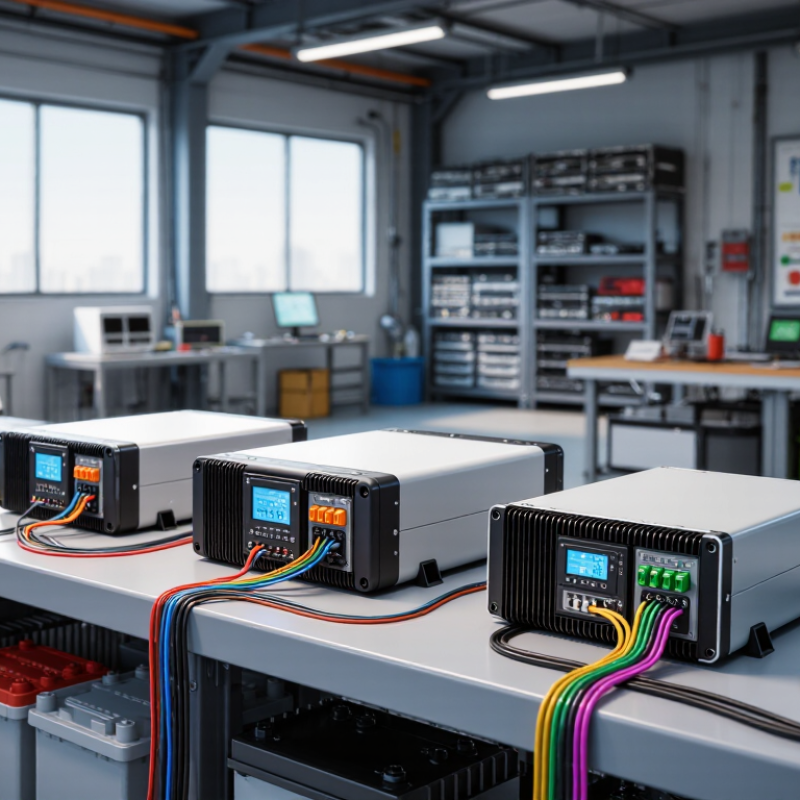
China Top 10 Hybrid Solar Charge Controller Manufacturers

Understanding Hybrid Solar Charge Controllers and Their Functions

A hybrid solar charge controller manages energy moving from photovoltaic panels into a battery system, and may coordinate charging from another source, such as grid power or a generator. Its job is practical: track solar output, regulate charging voltage and current, and help prevent overcharging or excessive battery discharge. Many models use maximum power point tracking (MPPT), which adjusts the operating point as sunlight and panel temperature change. The U.S. National Renewable Energy Laboratory notes that PV output varies with weather and operating conditions, so system design must account for real-world variation.

That matters as deployment grows. IRENA’s Renewable Capacity Statistics 2024 reports that global solar capacity expanded by about 346 GW in 2023. More installations mean more varied battery voltages, panel strings, and backup arrangements. A controller must match the battery chemistry, voltage, current rating, and system wiring; compatibility cannot be assumed from appearance alone. A tidy specification sheet still may not reveal how the unit behaves during heat or weak sunlight. Check operating limits and installation guidance.

Tips: Compare the controller’s maximum PV input voltage with the panel string’s cold-weather voltage. Leave a safety margin. Also confirm its supported battery settings and charging-current limit before installation.

Criteria for Identifying Leading Chinese Manufacturers

China Top 10 Hybrid Solar Charge Controller Manufacturers

Criteria for Identifying Leading Chinese Manufacturers

When assessing Chinese manufacturers, look beyond product photographs and headline efficiency figures. Check whether their controllers support the battery chemistry, system voltage, and charging profile your installation requires. Request clear specifications for maximum photovoltaic input, conversion efficiency, and operating temperature. Ask how the unit behaves during overloads, reverse polarity, or high temperatures. A supplier should explain these protections plainly, not hide them in vague claims. A polished brochure is not proof.

Request test reports, product manuals, and consistent model-specific data. Confirm that the stated performance applies to the exact controller being quoted, since similar-looking models can differ internally. Ask about production testing, component traceability, warranty handling, and access to replacement parts. Practical support matters: a useful answer about wiring or fault codes can save hours on site. Compare communication features, such as monitoring protocols, against your actual equipment. More features are not always better. If sample testing is possible, record charging behavior under changing sunlight and load. One limitation remains: public documents rarely reveal every production variation. Treat unanswered questions as a reason to investigate further, not as proof of poor quality.

China Top 10 Hybrid Solar Charge Controller Manufacturers — A Key Evaluation Criterion

Battery-voltage compatibility is a practical screening criterion when evaluating solar charge controllers. The chart shows common nominal battery-bank voltage classes—12 V, 24 V, 36 V, and 48 V—not manufacturer counts or rankings. Check each product datasheet to confirm supported battery voltages and system requirements.

Profiles of Ten Chinese Hybrid Solar Charge Controller Manufacturers

Chinese hybrid solar charge controller manufacturers vary in scale and technical focus. One profile is a power-electronics specialist offering configurable voltage and current ranges. Another focuses on compact units for small off-grid systems. A third emphasizes battery protection, with clear temperature and overcurrent limits. A fourth may provide custom interfaces for equipment integrators. These differences matter. Buyers should verify model-specific test reports, operating-temperature ranges, and support arrangements rather than relying on broad catalog claims.

A fifth manufacturer may concentrate on high-volume production and standardized models. A sixth could serve installers with straightforward displays and setup menus. A seventh may build controllers for larger battery banks, while an eighth focuses on monitoring and communication options. A ninth may offer engineering support for system matching. A tenth might serve export customers with multilingual documentation. These are useful supplier profiles, not independently audited company claims. A specification sheet can still leave gaps; I would ask for test conditions and warranty exclusions before comparing quotations.

Tips: Match controller voltage and current ratings to the actual panel array and battery chemistry. Request a wiring diagram and confirm protection features in writing. Details matter. A sample unit under realistic load can reveal confusing menus or heat buildup that a brochure will not show.

Key Technologies and Product Features Across the Industry

China Top 10 Hybrid Solar Charge Controller Manufacturers

Across China’s hybrid solar charge controller industry, product design increasingly centers on managing several power sources. Many units combine solar input with grid or generator charging, then direct energy to batteries and household loads. MPPT tracking helps adjust the operating point as sunlight changes. On a partly cloudy afternoon, that can mean steadier charging than a fixed-voltage approach.

Battery compatibility depends on more than a menu setting. Controllers may offer profiles for different battery chemistries, adjustable voltage limits, and communication with a battery management system. Protections against overheating, overcurrent, and reverse polarity add practical safeguards. Useful displays show charging current, battery voltage, and fault codes without requiring a technician to guess. Small details matter. Remote monitoring can help users spot unusual performance, though a connection is only useful when readings are clear and timely.

The strongest feature set is not automatically the best fit. Installers still need to check PV voltage limits, charging current, wiring requirements, and battery communication before commissioning. Thermal performance deserves attention in warm equipment rooms; specifications alone cannot describe every installation. Some interfaces remain harder to navigate than they should be. That is worth improving. Reliable products pair efficient power conversion with understandable controls and documentation that supports careful setup.

Applications, Market Trends, and Manufacturer Selection Factors

Hybrid solar charge controllers serve systems that combine photovoltaic panels with another charging source, such as a generator or utility supply. They are used in rural homes, farms, telecom sites, and backup systems where power availability can change by the hour. At a small installation, a controller may need to manage midday solar input, a cloudy afternoon, and battery charging overnight. Details matter.

Market demand is moving toward maximum power point tracking, clearer remote monitoring, and support for different battery chemistries. These features can improve energy use, but they do not fix poor system design. Buyers should check operating voltage, current capacity, temperature range, and protection against reverse polarity or overheating. A screen showing live input and battery status is useful when equipment sits far from daily supervision. Yet some monitoring functions depend on stable connectivity, which remote locations may lack.

When comparing manufacturers among China’s top ten hybrid solar charge controller suppliers, examine test documentation, warranty terms, spare-part access, and technical response times. Ask how the unit behaves when solar and auxiliary sources change suddenly. Request operating data for a configuration close to yours, not only a catalogue rating. Small inconsistencies in documentation deserve attention. They may be harmless, but they should be clarified before purchase. A low price alone says little about long-term serviceability.