Why Choose an Electric Trike for Commuting? The answer begins with stability, not speed. Three wheels can feel reassuring when traffic moves closely, especially during low-speed turns or sudden stops. A wide rear axle also offers practical carrying space for groceries, work tools, or a small backpack.
Richard Thorpe, founder of Gocycle and an experienced electric-mobility designer, has said, “The future of urban transport is about making journeys simpler.” That principle fits an Electric Trike For Commuting. It can replace short car trips while reducing parking stress and daily fuel use. The low step-through frame may help riders who dislike balancing a traditional bicycle. Electric assistance can also make hills and longer distances less intimidating.
Small details matter. A bright headlight helps on shaded streets. A sturdy rear basket keeps a laptop bag upright. Hydraulic brakes can provide more controlled stopping, although performance depends on maintenance and load weight. Local road rules, weather, battery range, and secure parking still require careful attention.
It is not perfect.
Some trikes are wider than expected. They may feel awkward beside parked cars or narrow bike lanes. Turning requires practice, and heavy cargo can change the handling. I would not promise that every commute becomes effortless. The better question is whether a trike matches your route, body, storage needs, and riding confidence. With a short test ride and realistic expectations, an Electric Trike For Commuting can become a steady, practical alternative for everyday travel.
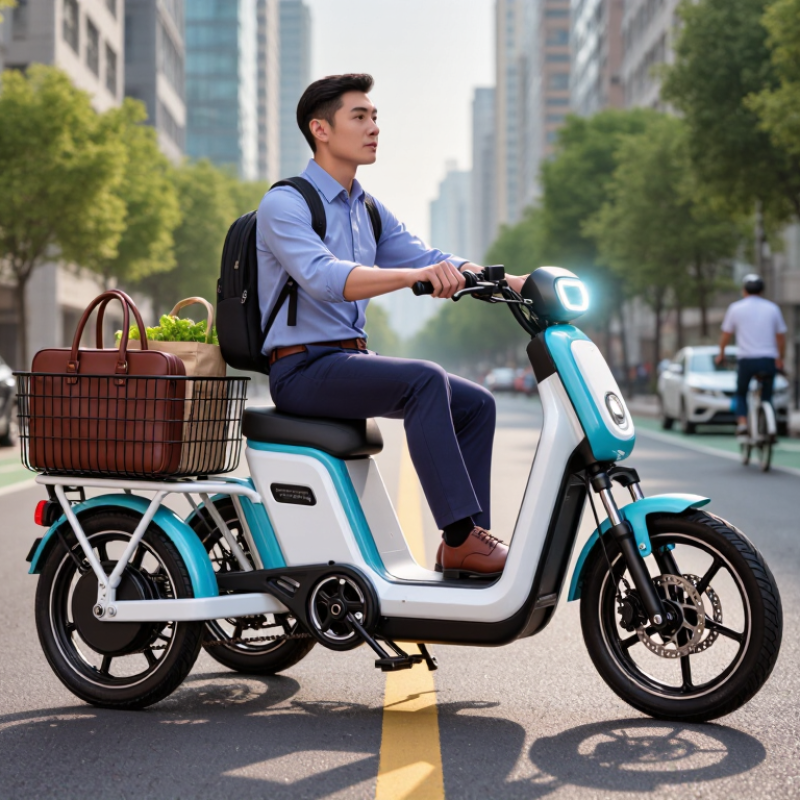
For daily commuting, an electric trike offers a different kind of confidence. Its two rear wheels create a wider base than a standard e-bike. That matters when carrying groceries, work tools, or a small child in a properly fitted seat. At a red light, you can remain seated without balancing on one foot. On wet pavement, however, stability does not remove every risk. Sharp turns still require slower handling.
The cargo difference is significant. Many electric trikes use a rear basket or a large box between the wheels. This space keeps heavy items low and reduces pressure on your back. I have found that a loaded trike feels steady on straight roads, especially during longer commutes. Yet extra weight makes hills and tight corners harder. Motor assistance helps, but it cannot replace careful route planning.
An e-bike usually feels narrower and quicker through traffic. It can fit bike lanes and crowded racks more easily. An electric trike needs more road space and a wider storage area at home. Parking can become annoying. I still misjudge its turning circle sometimes. Riders should practice braking, reversing, and cornering before carrying valuable cargo. Check tire pressure, battery condition, lights, and brake response regularly. A short test ride with realistic cargo often reveals more than specifications.
Why Choose an Electric Trike for Commuting?
An electric trike can make a daily commute feel steadier, especially with groceries, work equipment, or a child seat. Three wheels provide a planted stance at traffic lights and during slow turns. The frame may feel less agile than a bicycle, but that trade-off can reduce stress on crowded streets. A low step-through design also helps riders who dislike balancing while mounting.
In Europe, EN 15194 defines important limits for pedal-assisted cycles. The motor’s continuous rated power must not exceed 250 W. Assistance must also stop when the trike reaches 25 km/h. The motor should support pedalling, not replace it. This creates a gradual, predictable ride rather than a throttle-driven launch. On a flat road, the limit feels practical. Against strong wind, it can feel restrictive.
Riders should check the trike’s technical documents, especially its rated power and cut-off behaviour. Peak motor figures can sound impressive but may not describe legal continuous output. Local registration, lighting, helmet, and road-use requirements can differ. A test ride matters too. I have found that a heavy load changes braking distance more than expected. Rain, narrow cycle lanes, and steep hills still require judgement. The 25 km/h ceiling is clear, but real commuting is rarely so simple.
EN 15194 limits pedal assistance in Europe to 250 W and 25 km/h.
Under the European EPAC requirements referenced by EN 15194, the motor’s maximum continuous rated power is limited to 250 W, and assistance must progressively reduce and stop at or before 25 km/h. These limits support predictable, legally compliant commuting while allowing riders to benefit from electric assistance on starts, hills, and longer trips.
An electric trike can make commuting steadier, especially when groceries, work equipment, or uneven roads are involved. U.S. rules divide assisted bicycles into three practical classes. Class 1 provides motor help only while pedaling, stopping at 20 mph. Class 2 can use a throttle, but assistance also stops at 20 mph. Class 3 offers pedal assistance up to 28 mph and usually requires closer attention to helmet, age, roadway, and bike-path rules.
These categories are state-based, not a single nationwide operating permission. The U.S. Consumer Product Safety Commission defines low-speed electric bicycles around a 750-watt limit and a 20-mph motor-assisted threshold, while state statutes add Class 3 details. PeopleForBikes market data reported more than one million e-bikes sold annually in the United States from 2020 through 2023, showing strong practical interest. The 2022 National Household Travel Survey also found that private vehicles still carried most commuting trips, leaving room for compact electric transport.
On a Class 1 trike, a rider may pedal calmly through a neighborhood and arrive without excessive fatigue. A Class 3 model can shorten a longer commute, but 28 mph demands more braking distance and careful lane positioning. Faster is not always better. Local signs may restrict access, even when the vehicle meets its class definition. I would check the state code and route rules before every new commute; the legal map is still imperfect.
A practical comparison of U.S. electric-bicycle classes and commuting considerations for three-wheeled electric bicycles.
| Comparison Dimension | Class 1 | Class 2 | Class 3 | Why It Matters for Commuting by Electric Trike |
|---|---|---|---|---|
| Motor assistance limit | Up to 20 mph | Up to 20 mph | Up to 28 mph | Class 1 and Class 2 provide practical urban speeds, while Class 3 can shorten longer commutes where local rules permit its use. |
| How assistance starts | Pedal assistance only | Throttle can propel the trike without pedaling; pedal assistance may also be available | Pedal assistance only | Pedal-assist systems encourage active riding. A throttle can be useful for starting from a stop, managing hills, or moving a loaded trike. |
| Typical legal classification definition | Electric bicycle with operable pedals and a motor that stops assisting before 20 mph | Electric bicycle with operable pedals and a motor that can be activated without pedaling and stops assisting before 20 mph | Electric bicycle with operable pedals and a motor that assists only while pedaling and stops assisting before 28 mph | State statutes commonly use these three definitions, but exact requirements and terminology can differ by jurisdiction. |
| Federal power reference | U.S. federal consumer-product wording generally references a motor of less than 750 watts, although state and local laws may use different wording or limits. | Check the vehicle’s specifications and the rules where the trike will be operated, especially when the motor rating is near a legal threshold. | ||
| Pedaling requirement | Required for motor assistance | Not always required when throttle operation is available | Required for motor assistance | Pedal assist can provide a more predictable riding experience, while throttle control may improve convenience in stop-and-go traffic. |
| Stability advantage of a trike | Three wheels provide a stable platform when stopped and can support a lower-speed, balanced riding style. | Useful for riders carrying groceries, work equipment, or other cargo; riders still need to slow down for turns because three-wheel layouts can handle cornering differently from bicycles. | ||
| Carrying potential | A trike can accommodate a rear basket, front cargo area, panniers, or other purpose-built storage, subject to the vehicle’s rated capacity. | Extra cargo increases total weight, braking distance, and the effort required on hills. Always follow the manufacturer’s maximum load rating. | ||
| Best commuting environment | Bike lanes, neighborhood streets, greenways, and mixed-use paths where permitted | Urban streets and routes requiring frequent starts or low-speed maneuvering | Longer commutes and roads where higher assisted speed is legal and appropriate | Route design, traffic conditions, surface quality, and local access rules are often more important than the class alone. |
| Speed and safety equipment | A properly fitted helmet, front and rear lights, reflectors, a bell or audible warning device, and reflective clothing can improve visibility. | Higher speed and a wider vehicle profile increase the importance of defensive riding, clear signaling, and extra stopping distance. | ||
| Path and roadway access | Varies by state, city, agency, and facility | Do not assume that a Class 1–3 label guarantees access to every bicycle path, trail, sidewalk, or roadway. Confirm local rules before commuting. | ||
| Registration and licensing | Many U.S. jurisdictions do not treat compliant electric bicycles like motorcycles, but requirements vary. | Verify whether registration, a driver’s license, insurance, or age restrictions apply to the specific trike and location. | ||
| Weather and daily reliability | Battery range and braking performance can be affected by cold temperatures, hills, wind, payload, tire pressure, and riding speed. | For dependable commuting, plan charging around the round-trip distance and keep tires, brakes, lights, and battery connections maintained. | ||
| Most suitable commuter profile | Riders wanting straightforward pedal assist and broad low-speed usability | Riders prioritizing easy starts, cargo convenience, and throttle-assisted control | Riders seeking faster pedal-assisted travel on longer legal routes | The best class depends on local regulations, route length, traffic, cargo needs, riding ability, and the rider’s preferred level of physical effort. |
Important: U.S. electric-bicycle laws are not uniform. The Class 1–3 framework is widely used, but state, municipal, park, trail, and transportation-agency rules may impose additional requirements or restrictions. Confirm current local regulations before riding.
Why Choose an Electric Trike for Commuting?
Battery capacity shapes an electric trike’s daily usefulness more than a glossy range claim. A 400 Wh battery stores less energy than a 750 Wh battery, but real distance depends on weight, hills, wind, tire pressure, and assist level. The European Cyclists’ Federation places typical e-bike consumption near 1–2 kWh per 100 kilometers. A loaded trike often uses more. A practical planning figure is 15–25 Wh per kilometer.
That means a 400 Wh battery may deliver roughly 16–23 kilometers under demanding conditions. A 750 Wh battery may reach about 30–43 kilometers. These figures assume 85–90% usable capacity, not the full label value. Cold weather can reduce performance. Cargo changes everything. A route with frequent stops can also consume more energy than a steady ride.
Charging time deserves equal attention. A common 2-amp, 48-volt charger provides about 96 watts before charging losses. Charging 400 Wh can therefore take around five hours, while 750 Wh may need seven to nine hours. Faster chargers can reduce this window, but they may increase heat and battery wear. The U.S. Department of Energy’s vehicle guidance also emphasizes checking usable energy, charging losses, and operating conditions rather than relying only on rated capacity. I would measure one familiar commute for a week. Estimates are useful, but your own hills are less forgiving.
An electric trike can make commuting feel steadier, especially when carrying groceries, work equipment, or a child seat. Its three-wheel design offers more balance during low-speed turns and stops. Yet stability does not remove battery risks. The battery still needs careful handling.
CPSC battery-safety guidance gives commuters practical habits. Choose an e-trike with a battery and charger that meet recognized safety standards. Follow the supplied charging instructions. Avoid modified packs, damaged cables, and incompatible chargers. Charge on a hard, open surface, away from curtains, paper, and exit routes. Never charge while sleeping or away from home. Small details matter.
Check the battery before each ride. Look for swelling, cracks, unusual heat, leaking, or a sharp chemical smell. Stop using it if anything seems abnormal. Smoke or hissing requires distance and emergency assistance, not experimentation. Do not place a hot battery in a closet or vehicle. Let it cool in a safe, clear area.
A reliable commuting routine also includes secure mounting and dry electrical connections. Rain exposure may be manageable for some equipment, but water resistance is not waterproofing. Read the manual carefully. I would also keep a charging log, although that may feel excessive. Commuters often notice warning signs only after ignoring them twice. Even certified equipment needs responsible daily use.